All objects with temperatures above absolute zero are constantly emitting infrared radiation energy into the surrounding space. The magnitude of the infrared radiation energy of an object and its distribution by wavelength is closely related to its surface temperature. Therefore, the surface temperature of the object can be accurately determined by measuring the infrared energy radiated by itself, which is the objective basis on which infrared radiation temperature measurement is based.
Effect of object emissivity on radiation temperature measurement: Almost all actual objects in nature are not black bodies. In addition to the wavelength of radiation and the temperature of the object, the amount of radiation of all actual objects is also related to factors such as the type of material that makes up the object, the method of preparation, the thermal process, and the surface state and environmental conditions. Therefore, in order for the law of blackbody radiation to be applied to all real objects, a coefficient of proportion, i.e., emissivity, must be introduced in relation to the properties of the material and the state of the surface. This coefficient indicates the proximity of the thermal radiation of the actual object to the radiation of the black body, and its value is between zero and a value less than 1. According to the law of radiation, as long as the emissivity of a material is known, the infrared radiation characteristics of any object are known.
Note: Blackbody Radiation Law: A blackbody is an idealized radiator that absorbs radiant energy of all wavelengths, without reflection and transmission of energy, and its surface has an emissivity of 1. It should be pointed out that there is no real blackbody in nature, but in order to understand and obtain the distribution law of infrared radiation, it is necessary to choose a suitable model in theoretical research, which is the quantized oscillator model of body cavity radiation proposed by Planck, so as to derive Planck's law of blackbody radiation, that is, the blackbody spectral radiance expressed in wavelength, which is the starting point of all infrared radiation theories, so it is called the law of blackbody radiation.
The main factors affecting emissivity are: material type, surface roughness, physicochemical structure and material thickness. We mainly produce 12:1, 16:1, 30:1, 50:1 emissivity infrared thermometers, and other emissivity can also be customized according to customer needs.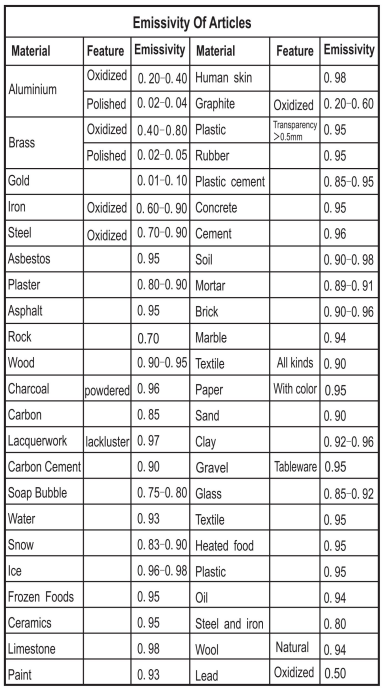
Different object emissivity reference sheet
When measuring the temperature of a target with an infrared radiation thermometer, the amount of infrared radiation within the range of the target must first be measured, and then the temperature of the measured target is calculated by the thermometer. In order to obtain accurate temperature readings, the distance between the thermometer and the test target must be within the appropriate range, which is the area of the thermometer's measuring point. The farther you are from the target, the larger the spot size will be. The ratio of distance to spot size, or D:S. On a laser sight type thermometer, the laser spot is above the center of the target and has a bias distance of 12 mm (0.47 inches).
When determining the measurement distance, it should be ensured that the target diameter is equal to or greater than the size of the spot to be measured. The distance between Object 1 and the gauge is positive, as the target is slightly larger than the size of the point being measured. Object 2 is too far away because the target is smaller than the size of the spot being measured, i.e. the thermometer is measuring the background object at the same time, which reduces the accuracy of the reading.


